Probability
Overview:
Terms and Definitions:
| Term | Explanation |
|---|---|
| Event | Set of outcomes from an experiment. Getting a tail when tossing a coin.Drawing Spade King from pack of cards |
| Types of Events | Independent, dependent, mutually exclusive |
| Independent Events | Each event is not affected by the other. Example: Tossing a coin twice. The outcome of the first toss does not affect the second one |
| Dependent Events | This is also called conditional. Example: drawing two cards from the deck without replacing the first one. The probabilities are impacted because there is fewer cards after the first draw |
| Mutually Exclusive | Two events cant happen at the same time. Example: Playing rugby and soccer in the same playing field at the same time. |
Basic Rules of Probability:
-
Rule 1: Probabilities must be between 0 and 1
Example:Probability of weather is sunny must be between0and1and usually represented as \[ 0 >= P(Weather = Sunny) <= 1 \]
-
Rule 2: Probability + complementary probability
equals to 1Example:Probability of weather is sunny + probability of weather NOT sunny = 1 \[ P(Weather = Sunny) + P(Weather != Sunny) = 1 \]
-
Rule 3: Probabilities of all events must add to 1
Example:If we are dealing with three events of weather say `sunny, rainy, and cloudy`, then the probability of all these should add up to 1 \[ P(Weather = Sunny) + P(Weather = rainy) + P(Weather = cloudy) = 1 \]
Contigency Table:
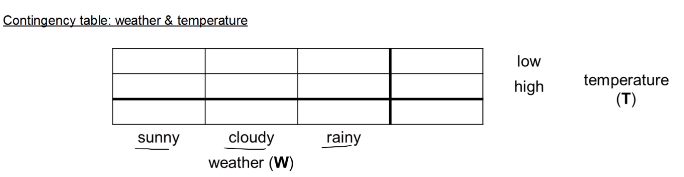
To know the interdependency of two variables or to know how one variable affects the other, contigency table can be used.
In the contigency table, on one axis plot all the events of one
variable and on the other axis plot all the events of the second
variable. For example, if we want to know how weather depends on
temperature and if there are three possible weather conditions
(sunny, rainy, cloudy) and two possible temperatures (low and high),
then these can be represented as follows in the contigency table.
Practice Problems:
Problem 1:
Suppose that in spring season 1% of people are infected with
flu. If you have the flu, you are tested positive with 95%
probability. If you are not infected, you are tested positive with
10% probability. Draw the contigency table.
Problem 2:
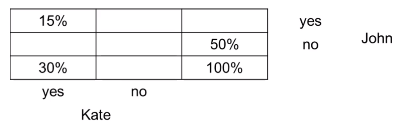
You have two friends John and Kate who like to go running. On any given day, here are the probabilities of John and Kate going for a run.
a) Complete the contigency table
b) Confirm if John running is independent of Kate running?